Part of: Quotes and leads you never followed up
Follow-ups
Youth sports sponsorship letter template that local businesses actually answer
A sponsorship letter template wired to a Google Sheets tracker, fixed tiers and two scheduled in-thread Gmail replies.
For directors and office managers at youth hockey academies and elite youth sports programs: a youth sports sponsorship letter template wired to a Google Sheets tracker, a tier structure, and a thread-based Gmail follow-up sequence.
Preseason is when the jersey print deadline, tournament fees and ice contracts all land at once. Sponsorship asks go out in a burst, usually by parents, with no shared record and no second touch. The letter rarely fails on wording. It fails on state: nobody knows who was asked, and nobody owns the follow-up.
The short answer
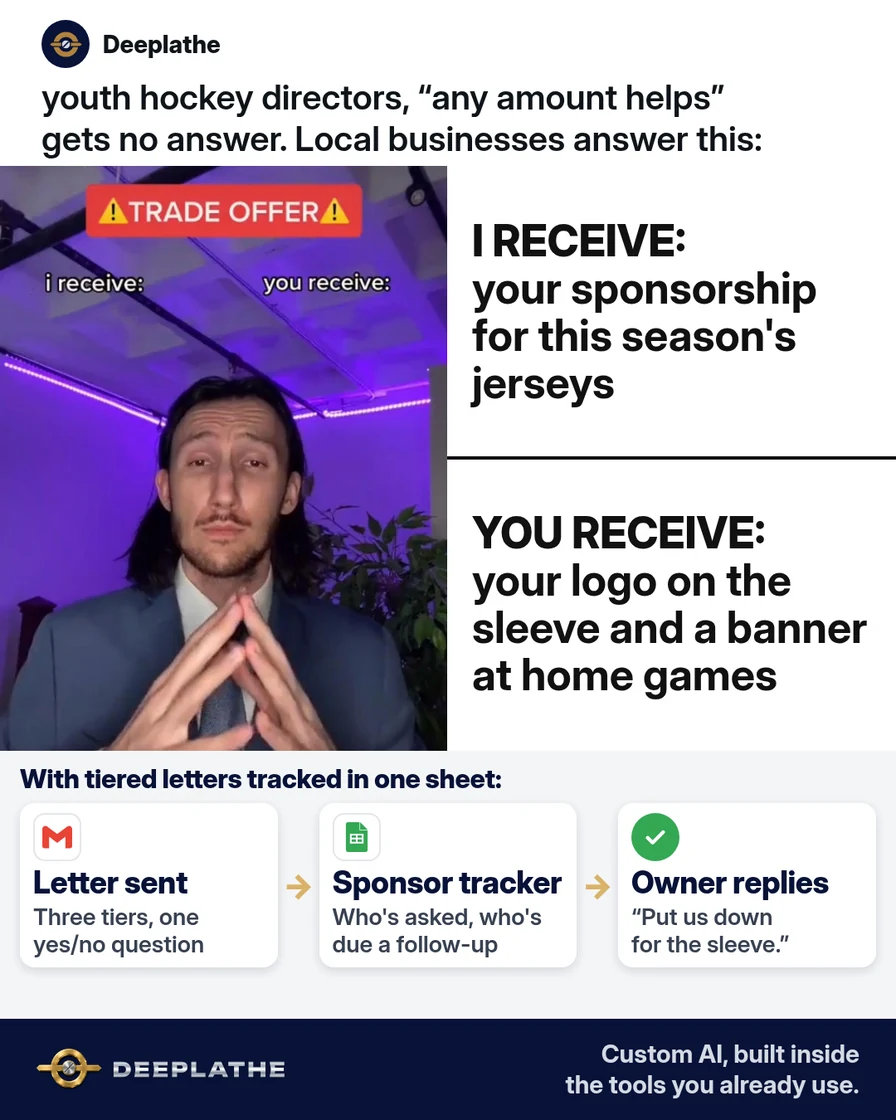
Treat the youth sports sponsorship letter template as one stage in a small pipeline, not a document. One row per business in a Google Sheet, one personal email per named owner, and two scheduled replies in the same Gmail thread on day 5 and day 12. AI fills the letter from row data and placeholders. The director approves each send, and the Status column is the single source of truth.
Why sponsorship letters go unanswered
Three failure modes stack up. First, an open-ended ask ("any amount") forces the business owner to design the deal, which raises the effort to reply. Fixed tiers turn it into a pick-one decision.
Second, a single-touch ask. A request that arrives once during the preseason rush competes with everything else in the owner's inbox. Replying in-thread keeps the original context visible and costs the reader nothing to re-read.
Third, no shared state. Distributed asks by parents and coaches produce duplicates and gaps. Without a tracker, no one can see who said "maybe," so maybes decay into silence.
There's also a classification issue for nonprofit programs. The IRS distinguishes a qualified sponsorship payment (name or logo acknowledgment) from advertising (comparative or qualitative language, price information, calls to buy). How you word a tier can change that treatment.
Floor vote
How does your program ask local businesses for sponsorship today?
One vote per device. Change it any time.
Loading votes…
Step 1: Build your sponsor tracker in Google Sheets
Create "Sponsors [SEASON]" with this header row:
Business | Owner first name | Owner email | Who knows them | Tier asked | Date sent | Day 5 sent | Day 12 sent | Status | Notes
Select the Status column and use Insert > Dropdown with the values Not sent, Sent, Talking, Yes, No, Next season. Add conditional formatting so overdue rows stand out. For example, use a custom formula on the row range:
=AND($I2="Sent", TODAY()-$F2>=5, $G2="")
That highlights any row sent five or more days ago with no day-5 follow-up logged. Duplicate the rule with column H and 12 days for the final touch.
If you run on LeagueApps, SportsEngine or Crossbar, export rosters or family records only to spot genuine business connections. Don't import families into the sponsor sheet or email the full list.
Step 2: Set three sponsor tiers before you ask
Anchor each tier to a real cost line so the sponsor can see what they fund:
TIER 1 - Team supporter: [AMOUNT 1]
- Name on website sponsor page
- One thank-you post on club social accounts

TIER 2 - Jersey or warm-up sponsor: [AMOUNT 2]
- Everything in Tier 1
- Logo on [SLEEVE / WARM-UP / PRACTICE JERSEY]
- Framed team photo for the business

TIER 3 - Season partner: [AMOUNT 3]
- Everything in Tier 2
- Rink board or banner at home games [IF RINK ALLOWS]
- Named on tournament or showcase schedule
Confirm board rights with the rink and the print cutoff with your jersey supplier first. If you collect sponsor money through LeagueApps, its eCommerce module supports products and donations on a hosted storefront, so a tier can be set up as a payable item with a shareable link.
Step 3: Fill the youth sports sponsorship letter template with AI
Keep player and family data out of the model. Pass only the row fields and program facts:
You write for a youth hockey academy. Draft a sponsorship request
email to a local business owner.
Inputs:
- Program: [PROGRAM NAME], [AGE GROUPS], [NUMBER] players
- Funds: [JERSEYS / ICE TIME / TOURNAMENT TRAVEL]
- Connection: [WHO KNOWS THEM] (or "none")
- Tiers: [PASTE THREE TIERS]
- Business: [BUSINESS NAME], [WHAT THEY SELL]
- Deadline: [REAL DEADLINE, e.g. jersey print date]
Constraints: under 170 words; open with the connection if present;
one sentence on the program, one on what the money funds; tiers as
a 3-line list; close with one yes/no question and an offer to visit.
Do not invent facts about the business or the program. No guilt,
no urgency beyond the stated deadline. Use acknowledgment wording
(name/logo), not ad copy (no "best", no prices, no "buy from").
Output skeleton to check the draft against:
Subject: Jersey sponsor for [PROGRAM NAME] this season?

Hi [OWNER FIRST NAME],
[CONNECTION LINE]
[PROGRAM LINE] [FUNDS LINE]
- Team supporter, [AMOUNT 1]: [BENEFIT]
- Jersey sponsor, [AMOUNT 2]: [BENEFIT]
- Season partner, [AMOUNT 3]: [BENEFIT]
Would one of these work for [BUSINESS NAME] this season?
[NAME] / [TITLE] / [PHONE]
Save the approved version under Settings > See all settings > Advanced > Templates, then More options > Templates > Save draft as template.
Step 4: Follow up on the sponsorship request in the same thread
Immediately after sending, open the sent thread, click Reply, write the day-5 note and use the arrow next to Send > Schedule send. Gmail allows up to 100 scheduled emails at a time, which covers a typical sponsor list. Then schedule the day-12 note the same way.
DAY 5: Hi [OWNER FIRST NAME], quick follow-up on the jersey
sponsorship. The order goes in on [DEADLINE]. Would [TIER 2] work,
or is a smaller option easier this year? [NAME]

DAY 12: Hi [OWNER FIRST NAME], last note from me. If the timing's
wrong, no problem, and I'll check back before next season. [TIER 1]
stays open until [DEADLINE]. Thanks either way, [NAME]
On any reply, cancel the pending scheduled message (Gmail's Scheduled folder) and update Status. A "No" ends the sequence.
Sponsor follow-up ladder
- Day 0The letterPersonal email to one named owner: connection, what the money pays for, three tiers, one yes/no question.
- Day 5The deadline noteReply in the same thread and name your real jersey or event deadline.
- Day 12The easy exitOffer the smallest tier or next season, then stop.
- After a yesThank and logThank them the same day, send a receipt or invoice, and log the logo file in your sheet.
- Day 0, the letter: row data plus tiers, one yes/no question.
- Day 5, the deadline note: in-thread, cites the real print or event date.
- Day 12, the easy exit: smallest tier or next season, then stop.
- After a yes: same-day thanks, receipt or invoice, logo file logged in Notes.
Example (illustrative): a hockey academy with 80 players
A walkthrough, not a client story. Four teams, one director, a part-time office manager. The sheet holds 30 businesses, half with a parent connection. The office manager drafts letters from row data with the prompt. The director edits, sends from Gmail and schedules both replies. Conditional formatting surfaces overdue rows every Monday.
At a glance
- Problem: single-touch letters, no shared record.
- What was set up: Sheets tracker with dropdown and overdue highlighting, three tiers, AI-drafted letter, two scheduled in-thread replies.
- Tools it lives in: Google Sheets, Gmail templates, Gmail scheduled send, optionally LeagueApps eCommerce for payment.
- What the owner still does: picks targets, sets tiers, approves every send, thanks sponsors.
- Payoff: not measured here. Compare yes rate to last season.
Mistakes to avoid
- Open-ended asks. Fixed tiers reduce the reply effort.
- Unconfirmed benefits. Check rink advertising rights and print cutoffs first.
- Model-invented facts. Every factual blank is filled by a person.
- Ad copy in a nonprofit tier. Qualitative or price language can turn an acknowledgment into advertising. Ask your accountant.
- Orphaned scheduled sends. Cancel pending replies the moment an owner answers.
Field check
Field check
Three questions. Honest answers. No score sent anywhere but this page.
01 / 03
What gets more sponsor replies than asking for "any amount"?
If it still doesn't work
Low reply rate usually traces to cold rows. Filter the sheet to rows with a blank "Who knows them" and route those through a parent intro or an in-person drop-off. "Not now" rows move to Next season with a Google Calendar reminder six weeks before your next print deadline. Many small yeses and no top-tier yes means Tier 3 lacks a visible benefit.
Doing this inside the tools you already use
Deeplathe is a team of developers and solution builders who build custom AI inside the tools a business already uses. Here, a custom build could watch your sponsor sheet, draft a personal letter for each new row from its connection and tier, and queue the day-5 and day-12 replies in the same Gmail thread. It would skip anyone who has replied and write the status back to the sheet. Nothing sends until you approve it, and you choose who gets asked. See how a custom build works.
FAQ
How do you write a letter asking for sports sponsorship?
Map it to fixed slots: connection, program, what the money funds, three tiers, one yes/no question. Keep it under 200 words and send it to a named owner. Use a prompt that takes only those fields so every letter stays personal without a rewrite.
What should a youth sports sponsorship letter include?
Program name, age groups, player count, the specific cost being covered, tiered benefits, a real deadline and contact details. For nonprofits, word benefits as acknowledgment (name, logo) rather than advertising, since the IRS treats the two differently.
How do you follow up on a sponsorship request?
Schedule two in-thread replies when you send the letter: day 5 citing the real deadline, day 12 offering the smallest tier or next season. Cancel both on any reply and log the outcome in the tracker.
Is a youth sports sponsorship tax deductible for the business?
It depends on the program's tax status and what the sponsor receives. IRS Publication 598 covers how exempt organizations treat qualified sponsorship payments versus advertising. Don't promise a deduction in the letter; point sponsors to their accountant.
Keep these
- Three tiers tied to real costs.
- One row, one owner, one personal email.
- Day 5 and day 12 in-thread, then stop.
- Acknowledgment wording, not ad copy.
Sources
- IRS Publication 598: Tax on Unrelated Business Income of Exempt Organizations (qualified sponsorship payments)
- Gmail Help: Schedule emails to send
- Google Docs Editors Help: Create an in-cell dropdown list
- LeagueApps Help: How to create and manage eCommerce products
Related reading
Keep these
The working rules
One row per business in Google Sheets, one personal email per named owner, two scheduled in-thread Gmail replies; Status is the single source of truth.