Part of: The process that only lives in your head
SOPs
Travel itinerary template in Google Docs for travel advisors (free copy)
For travel advisors: a master Google Docs template with place chips and building blocks, AI extraction from confirmation emails with CHECK markers, and a line-by-line verification pass.
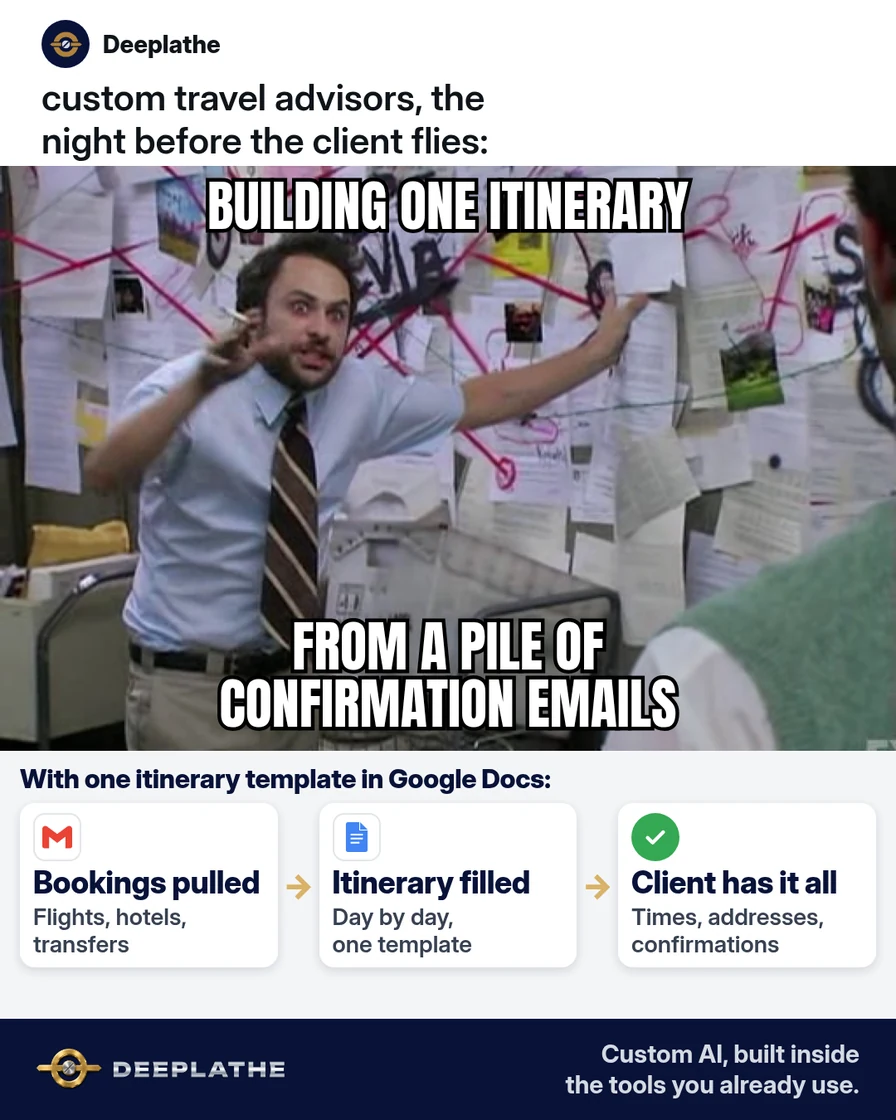
It's 9 p.m., and you're still building a ten-day itinerary for a couple heading to Portugal. The flights, two hotels, a private transfer and a wine tour are all booked. But every detail sits in a different confirmation email, and you're copying times into a document one line at a time. A good travel itinerary template in Google Docs, filled from those emails with AI, turns that evening into about half an hour of checking.
The short answer
Treat the itinerary as a fixed schema plus an extraction step. The schema is a master Google Doc with eight sections in a fixed order. The extraction step is an AI prompt that reads the trip's confirmation emails and returns only typed fields, sorted by local date and time. The model extracts, it never fills a gap: missing or ambiguous values come back as "CHECK", and confirmation numbers are pasted by hand. One copy of the master per trip.
Why itineraries take hours to build
The cost isn't planning. It's format translation. Each supplier sends its own email layout, so every booking needs a manual parse: find the date, the local time, the address and the reference, then map them into a document whose layout drifts from trip to trip.
Two fixes remove most of that work. A fixed schema removes the layout decisions, because every field has one home. An extraction prompt removes the parsing, because it reads the emails and returns the fields in the schema's order. What stays human is verification and the advisor's own notes, which is where the client's value sits anyway.
Floor vote
Which part of building a client itinerary takes you longest?
One vote per device. Change it any time.
Loading votes…
Step 1: Copy this travel itinerary template into Google Docs
Create "MASTER - Client itinerary" and paste the outline. The section order runs from what the client needs first (who to call, how to get there) to what they need only if something breaks.
[TRIP NAME] - [CLIENT LAST NAME] - [START DATE] to [END DATE]

1. TRIP AT A GLANCE
   Travelers: [NAMES AS ON BOOKINGS]
   Destinations: [CITY 1] > [CITY 2] > [CITY 3]
   Trip dates: [START DATE] to [END DATE]
   Your advisor: [YOUR NAME], [PHONE], [EMAIL]

2. WHO TO CALL
   Advisor during travel: [PHONE, HOURS]
   24/7 emergency line: [SUPPLIER OR AGENCY NUMBER]
   Local contacts: [DMC / GUIDE / DRIVER, PHONE]

3. FLIGHTS
   [DATE] | [AIRLINE + FLIGHT NO.] | [FROM] [DEPART TIME] > [TO] [ARRIVE TIME]
   Confirmation: [PASTE FROM EMAIL]   Baggage: [ALLOWANCE]

4. WHERE YOU'RE STAYING
   [HOTEL NAME] | [ADDRESS AS PLACE CHIP] | Check-in [TIME] [DATE]
   Check-out [TIME] [DATE] | Room: [TYPE] | Included: [BREAKFAST ETC.]
   Confirmation: [PASTE FROM EMAIL]

5. GETTING AROUND
   [DATE] [TIME] | [TRANSFER / CAR / TRAIN] | Pickup: [PLACE]
   Driver or company: [NAME, PHONE] | Confirmation: [PASTE FROM EMAIL]

6. DAY BY DAY
   Day [N] - [DATE] - [CITY]
   Morning: [PLAN, MEETING POINT, TIME]
   Afternoon: [PLAN]
   Evening: [DINNER RESERVATION, TIME, ADDRESS]
   Advisor note: [YOUR PERSONAL TIP]

7. DOCUMENTS AND MONEY
   Entry rules to check: [PASSPORT VALIDITY, VISA OR TRAVEL AUTHORIZATION]
   Paid: [WHAT IS PAID]   Due locally: [TAXES, TIPS, BALANCES]
   Insurance: [PROVIDER, POLICY CONTACT]

8. IF PLANS CHANGE
   Missed flight: [WHAT TO DO FIRST]
   Late arrival at hotel: [WHO TO TELL]
   Cancellation terms: [KEY DEADLINES]
Data minimization starts here. The schema has no field for passport numbers, birth dates, card data or loyalty numbers, so there's nowhere for them to land, even by accident.
Step 2: Set up the template with smart chips and building blocks
Place chips. Type @ plus a place name, or use Insert, then Smart chips, then Place. A pasted Google Maps link turns into a chip when you press Tab. The chip opens the location in Google Maps and offers directions, which is what a client on a phone actually needs.
Date chips. Use @date or a typed date like "@May 14" in each day heading, so dates are structured rather than free text.
Custom building blocks. On eligible Workspace work accounts, highlight reusable content, right-click, choose Save as custom building block, name it and select Create. Insert it with @ plus its name or Insert, then Building blocks, then Custom building block. Each block is stored as a Doc in Drive's "Custom Building Blocks (auto-generated)" folder, and you need copy access to the source content to create one. Good candidates: your "If plans change" text, your emergency contacts, and standard transfer notes per city.
Copy, don't edit. File, then Make a copy per trip, named "[LAST NAME] [DESTINATION] [START DATE]", so the master never holds client data.
Step 3: Fill the itinerary from booking emails with AI
Gemini in Docs or Gmail needs an eligible Google Workspace or Google AI plan. In the trip's Doc, select Ask Gemini, then Add sources, then Gemini search settings, and confirm Gmail search is on. Google notes that Gemini can still get sources wrong, which is why the prompt forces "CHECK" on gaps. The prompt constrains scope (suppliers and dates), output fields and exclusions:
Search my Gmail for booking confirmations for the trip to [DESTINATION]
from [START DATE] to [END DATE], from these suppliers: [AIRLINE],
[HOTEL 1], [HOTEL 2], [TRANSFER COMPANY], [TOUR COMPANY].

For each booking, list only:
- type (flight, hotel, transfer, tour)
- date
- start time and end time, with the local time zone
- place names and addresses
- what's included (breakfast, baggage, guide)
- cancellation deadline, if the email states one

Sort everything by date and time. Use the headings FLIGHTS,
WHERE YOU'RE STAYING, GETTING AROUND and DAY BY DAY.
Write "[CONFIRMATION]" where a confirmation number goes. Do not
include traveler dates of birth, passport, payment or loyalty numbers.
If a detail is missing or unclear, write "CHECK" instead of guessing.
ChatGPT, Claude or Copilot don't see your inbox, so you supply the text. Copy only the booking block of each confirmation and redact names, passport numbers, birth dates, card digits and loyalty numbers first (what to cut before pasting). Run the prompt from "For each booking".
Confirmation numbers are excluded from the model on purpose. They're short alphanumeric strings where one wrong character breaks a check-in, so they go from the email to the doc by copy and paste.
Step 4: Check every line and send the itinerary
Verify against the source emails, not against the model's output:
[ ] Every flight: date, flight number, times, airport codes
[ ] Every hotel: check-in and check-out dates match the nights booked
[ ] Every transfer lines up with the flight it meets
[ ] Every "CHECK" is resolved, none left in the doc
[ ] Every confirmation number pasted from the original email
[ ] Place chips open the right address
[ ] Day-by-day has your personal notes, not just bookings
Share with Share, client email, Viewer, or export with File, then Download, then PDF document. A shared Doc stays current when bookings change. A PDF is a snapshot, so re-export after every change.
The itinerary workflow
- OnceBuild the master30 minutes: place chips and building blocks
- New tripMake a copy1 minute, named for the client and dates
- After bookingRun the AI promptAgainst the trip's confirmation emails
- Before sendingCheck every linePaste confirmation numbers, add your notes
- Any changeUpdate the same docThe client's link always shows the latest
The same workflow as a list:
- Once, 30 minutes: build the master template with place chips and building blocks.
- New trip, 1 minute: File, then Make a copy, named for the client and dates.
- After booking: run the AI prompt against the trip's confirmation emails.
- Before sending: check every line, paste confirmation numbers, add your notes.
- Any change: update the same doc, so the client's link always shows the latest version.
Example (illustrative): a two-advisor custom travel agency
This is a walkthrough, not a client story. An owner and one advisor plan custom European trips from a shared Workspace inbox. The owner keeps the master and three building blocks. The advisor copies the master per trip, runs the Gemini prompt, and pastes the output. The owner resolves every "CHECK", cross-checks transfers against flight arrivals, adds restaurant notes and shares as Viewer.
At a glance
- Problem: itineraries rebuilt from scratch out of a dozen confirmation emails.
- What was set up: one master Google Docs template, an AI prompt, and a checklist.
- Tools it lives in: Gmail, Google Docs and Gemini.
- Owner still does: checks every line, adds personal notes, decides what goes in.
- Payoff: not measured here. Time your next three itineraries and compare.
Mistakes to avoid
- Allowing inference. Without the "CHECK" rule, a model may fill a missing time with a plausible one.
- Sending regulated or payment data to a chat tool. The schema doesn't need it, so redact before pasting.
- Editing the master. Client data leaks into every future copy.
- Normalizing time zones. Keep each time local to where it happens and label the zone in the prompt output.
- Delegating judgment. Pacing, restaurant choice and rest days stay with the advisor.
Field check
Field check
Three questions. Honest answers. No score sent anywhere but this page.
01 / 03
Do you copy a master template instead of editing the last trip?
If it still doesn't work
Gmail search misses usually mean the booking lives in a PDF attachment or a different inbox. Open it, copy the text and use the paste route. If output quality drops on long trips, run the prompt per booking type (flights, then stays, then transfers) to keep each request small.
If you use an itinerary platform, test its import first. Travefy gives each itinerary a trip-specific email address under +New Event, then Flights or Lodging. Forward the original, unedited HTML confirmation, and it imports from over 1,500 supported suppliers, usually within 2-3 minutes. It doesn't support wholesalers, complex FIT itineraries, PDFs or quotes, and it notifies you when an import fails. Those bookings still go through the template.
Under the hood
- Schema first. Eight fixed sections mean the extraction output maps one-to-one to headings.
- Scoped retrieval. Naming suppliers and dates narrows the Gmail search, so Gemini doesn't pull an older trip.
- Fail closed. "CHECK" turns a silent error into a visible to-do.
- Human-only fields. Confirmation numbers and personal notes never pass through the model.
Doing this inside the tools you already use
Deeplathe is a team of developers who build custom AI inside the tools a business already uses. For this job, a custom build could watch your bookings inbox, match each confirmation to the right trip by dates and supplier, and fill that trip's Google Doc in your template's schema. It marks anything ambiguous "CHECK" and never copies passport or payment fields. You review, add your notes and share, and supplier change emails update the same doc.
You keep the client relationship, and the retyping stops. See how a custom build works.
FAQ
What should a travel itinerary include?
A trip summary, who to call, flights, hotels with check-in and check-out times, transfers, a day-by-day plan, documents and money notes, and what to do if plans change. Each booking carries its confirmation number and a tappable address. Passport numbers and card details stay out, because the document gets forwarded and doesn't need them.
Does Google Docs have a travel itinerary template?
You don't need a built-in one. Paste the outline above into a blank doc, keep it as a master and use File, then Make a copy per trip. On eligible Workspace accounts, custom building blocks store reusable sections as Docs in Drive, and you insert them by typing @ and the block's name.
Should I use Google Sheets or Google Docs for an itinerary?
Docs for the client-facing itinerary, because headings, prose notes and place chips read well on a phone. Sheets for your internal booking tracker, one row per booking with status and deadlines. The extraction prompt works for either: ask for rows instead of headings if you're filling a sheet.
Is it safe to put booking emails into ChatGPT?
Only after redaction. Copy the booking block, delete names, passport numbers, birth dates, card digits and loyalty numbers, then paste. Confirmation numbers go into the doc by hand. Gemini inside your Workspace account reads the email in place, but the prompt still excludes those fields from its answer.
Keep these
- One master template, a fresh copy for every trip.
- AI pulls the times, you check every line.
- Confirmation numbers come straight from the email.
- No passport, birth date or card details, anywhere.
Sources
- Google Docs Editors Help: Insert custom building blocks
- Google Docs Editors Help: Insert place chips
- Gmail Help: Collaborate with Gemini in Gmail
- Google Docs Editors Help: Use sources with Google Workspace with Gemini
- Travefy Help Center: How to forward booking confirmation emails
Related reading
Keep these
The working rules
Fixed-section document template, constrained extraction from confirmations with explicit CHECK tokens, and a human verification checklist before sharing.