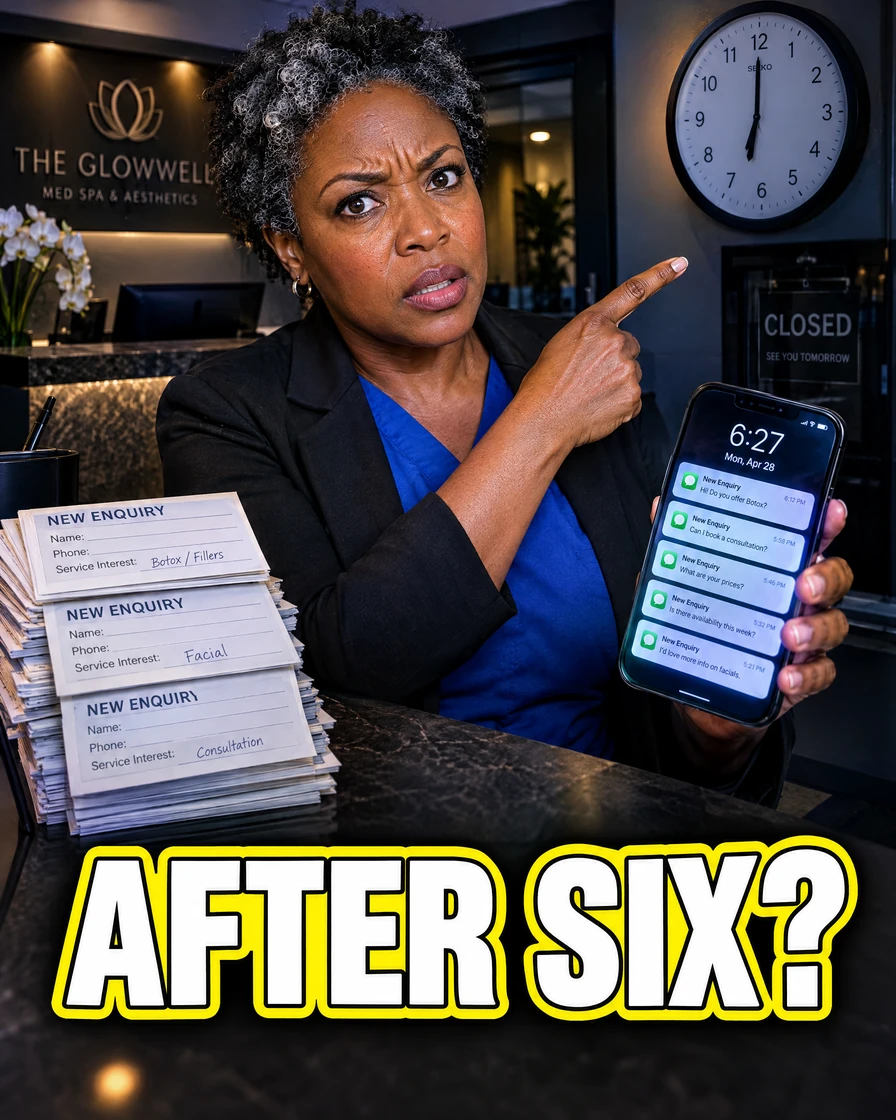
What happens to your clinic's enquiries
What happens to your clinic's enquiries after six — and the agent we built to answer them
Someone sees your before-and-after at nine on a Tuesday evening, taps the number in your bio, and gets the answerphone. They do not leave a message. They go back to the search results and ring the clinic below you. By the time you hear the voicemail on Wednesday morning, the consultation is booked somewhere else — and you never knew it happened, because a call that was never answered leaves no trace anywhere you look.
Every clinic has a version of this conversation. The enquiries do not arrive between nine and five, because that is when people are at work. They arrive in the evening, in bursts, after something lands on a feed — and they arrive at four clinics at once, because nobody rings only you.
The part that is invisible is the cost. A missed call does not appear in any report. There is no line in your practice software that says "a consultation went to the clinic on the other side of town at 9:14pm on Tuesday." The number of those is not zero, and you cannot see a single one of them.
What follows is how to build a phone line that answers those calls in your clinic's own words — treatments by name, price handled honestly, details taken discreetly — using tools that exist today and cost less per month than a single consultation.
The mechanism
How it is built, in full
What the agent actually has to do
An aesthetics enquiry is not a generic enquiry. Four things come up on nearly every one, and an agent that cannot handle them politely is worse than voicemail.
It has to know your treatment list by its real names. Not "injectables" — profhilo, polynucleotides, the specific toxin brand you use. A caller who says "I saw the polynucleotide post" and gets "I'm sorry, could you repeat that?" has already decided.
It has to handle price without quoting price. This is the hard one. Aesthetics callers ask what it costs on the first call, and the honest answer is that it depends on the assessment. The agent needs a line that is true, does not stonewall, and moves to the booking: what the consultation costs, that the treatment is quoted after the assessment, and that the assessment is the appointment being offered.
It has to be discreet by default. People do not want a detailed voicemail about their chin left on a shared phone. The agent takes a first name and a number, confirms nothing back in detail, and says a member of the team will call.
It has to know when to stop. Anything medical — a lump, swelling after a treatment, a reaction — is not a booking enquiry. The agent takes the details and flags it as urgent rather than offering a slot in three weeks.
Building it
1. Write the knowledge base first, not the prompt. Four files. Treatments with the names patients actually say, including the brand names and the slang. Prices as a consultation fee plus a range, with the rule about when a number can be given. Practitioners, their qualifications, and their days. Opening hours including the ones you do not publish.
The temptation is to write a clever system prompt and let the model improvise the rest. It will improvise a price, and that price will be wrong.
2. Set the first line before anything else. The greeting decides whether the caller stays on. Name the clinic, then ask one open question. Do not announce that you are speaking to an assistant in the opening line — say it if asked, and answer honestly, but leading with it invites the caller to hang up before they have said what they wanted.
3. Give it exactly one job to finish. Take the name, the number, and what they are asking about, then end. An agent asked to also qualify budget, book the slot, and take a deposit will do all four badly. The booking happens when your front desk rings back with the notes already in hand.
4. Wire the handoff to where you already look. A text to the practice mobile within seconds, and an email with the transcript. If the notes land somewhere nobody opens until Friday, the agent has moved the problem rather than solved it.
5. Break it on purpose before a patient does. Ring it yourself with an accent it has not heard, with a television on, from a car. Ask it something it does not know and listen to what it invents. Ask it the price of a treatment you deliberately left out of the knowledge base. Whatever it says in that moment is what it will say to a patient at nine at night.
What still goes wrong
It mishears treatment names on a bad line. It occasionally answers a question it should have deflected. It cannot tell an anxious caller from a curious one, and sometimes that matters.
None of that is a reason to leave the phone ringing out. It is a reason to check the transcripts every morning for the first fortnight and keep fixing the knowledge base, which takes a few minutes and gets shorter every week.
Floor vote
Where are you with this job?
One vote per device. Change it any time.
Loading votes…
Field check
Field check
Four questions. Honest answers. No score sent anywhere but this page.
01 / 04
Can you name the one job this piece is for, in one sentence?
Or we run it
Setting this up properly is a week of evenings and a knowledge base you have to keep current. If you would rather not, we build it and run it for you — the clinic website, the Google listing, and the phone answered day and night — for a fraction of what a part-time receptionist salary costs, and nobody's hours change.