Automations
Roof warranty registration tracking: a Friday list of finished roofs nobody registered
A Friday email lists every finished roof whose enhanced warranty was never registered, so your office stops checking the portal and none slip past.
The short answer
Every roof you finish now gets its manufacturer warranty registered on time, because a list of the ones nobody filed lands in your inbox every Friday morning.
A scheduled AI task reads your own job-complete notices and contracts, matches them against the registration confirmations in your inbox, and sends you only the gaps. Nobody keeps a spreadsheet or cross-checks the portal. Your office spends a few minutes registering the two or three roofs on the list, and the warranty you sold is actually in force.
What it costs you now
Here's how roof warranty registration usually works. The crew finishes, the job gets marked complete, and somebody in the office is supposed to log into the manufacturer's contractor portal and register the warranty. In October, with the fall rush closing out, that "somebody" is also chasing final payments, ordering materials for next week and answering homeowners. Registration happens when someone remembers.
The rules aren't forgiving. GAF says its enhanced warranties (System Plus, Silver Pledge, Golden Pledge) must be registered by the contractor within 45 days of installation. The homeowner can't do it for you. GAF's base shingle warranty doesn't need registration, but the enhanced ones you sold as the premium option do. CertainTeed's longer SureStart PLUS coverage is only available through credentialed contractors, and it adds tear-off, disposal and, on the higher tiers, workmanship coverage. So the warranty you used to win the job depends on paperwork your office files after the job is done.
What that costs you, as an example:
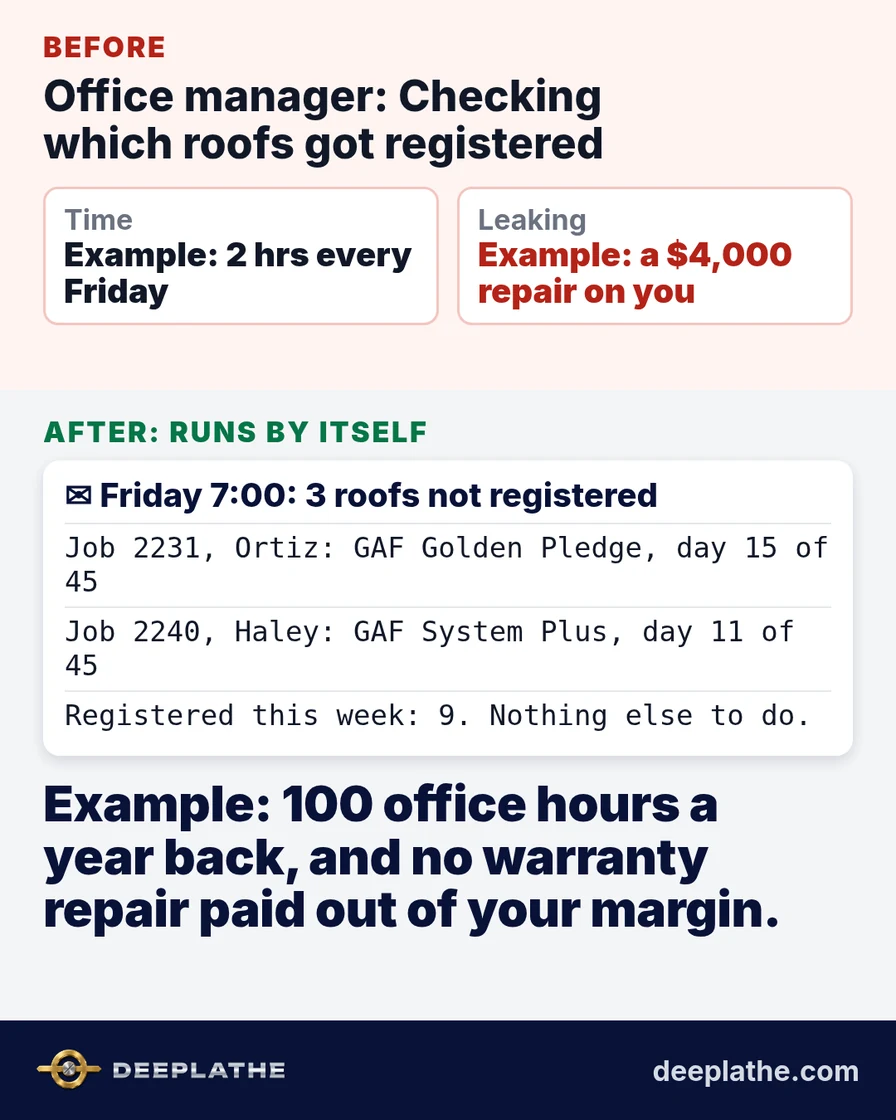
Example: your office manager spends about 2 hours every Friday going through the week's finished jobs, opening the portal and checking which ones show as registered. That's around 100 hours a year of checking, not registering.
Example: even with that check, 1 or 2 roofs a month slip, usually the ones that closed the week someone was out sick. Most never come up again. But if one of them leaks in year three and the enhanced warranty was never issued, the homeowner comes to you, not the manufacturer. Example: a $4,000 leak repair with tear-off and disposal comes out of your margin instead of being covered. Plus a homeowner who paid for the premium warranty and is about to review you.
The risk is quiet. You don't find out about a missed registration when it happens. You find out years later, when it's too late to fix.
What runs by itself
The job is simple to describe. Every Friday at 7:00, an AI task looks at two kinds of email you already get.
The first is your job-complete notices. JobNimbus, AccuLynx and similar job software can send an email or start an automation the moment a job moves to complete, and the contract on that job says which warranty you sold (base, System Plus, Golden Pledge, a SureStart PLUS tier). The second is the manufacturer's registration confirmations and receipts, which come back to your inbox after someone registers in the portal.
The task matches the two. Every finished job that was sold with an enhanced warranty and has no matching confirmation goes on the list, with the completion date and how many days have passed. Jobs sold with a base warranty that doesn't need registration stay off the list, so the email only shows what needs action. If everything is registered, you get a one-line "all clear" or nothing at all, whichever you prefer.
It runs as a scheduled task in ChatGPT, Claude or Gemini connected to your Gmail or Outlook, or as a Zapier or Make automation where the AI reads each job, if you want it to start from your job software instead. We can set this up for you.
Example: what lands in your inbox
Illustrative sample of the Friday email:
Warranty registrations: 3 finished roofs with no confirmation (Fri 17 Oct, 7:00)
Job 2231, Ortiz, 41 Birch Ln: completed 2 Oct, GAF Golden Pledge on contract. Day 15 of GAF's 45-day window.
Job 2240, Haley, 9 Ridge Ct: completed 6 Oct, GAF System Plus. Day 11 of 45.
Job 2219, Brandt, 220 Mill Rd: completed 25 Sep, CertainTeed SureStart PLUS 4-Star. Check CertainTeed's registration terms.
Registered this week: 9. Base warranty only (nothing to file): 4.
Your office registers three roofs and moves on. Nobody checked the other nine.
The time and money math
These are assumptions, labeled as examples. Plug in your own numbers.
Example time: 2 hours of Friday checking, 50 weeks a year, is 100 office hours. With the list, the checking is zero. What's left is the registering itself, and that only for the roofs on the list. At $25 an hour for office time, that's about $2,500 a year in wages you can spend on collections or scheduling instead.
Example money, protecting margin: if one unregistered roof every year or two turns into a $4,000 repair you end up paying for, catching those before the window closes saves $2,000 to $4,000 a year.
Example money, growing revenue: once you trust that every enhanced warranty gets filed, your sales reps can offer it on every quote without hesitation. Example: if the premium warranty adds $400 of margin per roof and you sell it on 5 more roofs a month, that's $2,000 a month.
Put together, the example is about 100 office hours back and a few thousand dollars a year protected, plus whatever the premium warranty adds once your reps stop holding back.
Where it goes wrong (limits)
It can only see what reaches your inbox. If your manufacturer's portal doesn't email a confirmation, or the emails go to a sales rep's personal mailbox, the task will flag roofs that were actually registered. The fix is to route confirmations to one shared address, or connect the task to the portal's own registration report if your plan supplies one.
It reads the warranty type from the contract on the job. If a rep wrote "premium warranty" without naming which one, the line will say "warranty type unclear" instead of guessing. That's on purpose.
The day count starts from the job-complete date in your software. GAF counts from installation. If jobs often sit at "complete" days after the crew leaves, the count will run short, so treat any roof past day 30 as urgent.
Deadlines differ by manufacturer and by warranty. We only quote a window when the manufacturer publishes one. For everything else, the list tells you to check your manufacturer's window instead of making one up.
It doesn't register anything. Portals need your login and payment for some warranties, and that should stay with a person. The task finds the gaps. Your office fills them.
What if it still doesn't work for you?
Some shops register every roof the day it finishes, from the truck, and never miss. If that's you, you don't need this. The Friday email will keep saying "all clear," and you can switch it off.
If your job software doesn't send completion emails, the task can read the weekly job report it already emails you, or we set the starting signal inside the software itself. If the flags are wrong for a couple of weeks, it's almost always a matching problem: a job number written two different ways, or confirmations going to the wrong mailbox. That gets fixed once and stays fixed.
The free fallback is a reminder 30 days after each job closes. But that's still a person remembering, the part that fails in October.
Built inside the tools you already use
This doesn't need new software. The list is built on the email account, job software and AI subscription you already pay for, and it only reads. It never logs into a portal, pays for a warranty or emails a homeowner. You decide what goes on the list and who gets it, and you can turn it off with one switch. If you'd like it built and checked for you, see /solutions. If you want to understand what an agent like this does on its own, read what agentic AI means for a business.
Questions owners ask
What does it cost to run?
If you already pay for ChatGPT, Claude or Gemini on a plan with scheduled tasks and email connectors, the running cost is mostly that subscription. A Zapier or Make version depends on your plan and how many jobs you close. Setup is a one-time job. For a way to weigh it, see how to measure AI ROI in a small business.
Will it work with my manufacturer and my job software?
If your job software can send a completion email or fire an automation, and your manufacturer's confirmations reach an inbox, yes. GAF, CertainTeed, Owens Corning or a mix makes no difference to the matching. The warranty rules on the list come from each manufacturer's published terms.
What if it breaks or misses a roof?
Every Friday email includes a count of jobs it checked. If that number looks low next to your week, something upstream changed, like a renamed status or a new mailbox. It fails loudly instead of quietly.
Is my customer data safe?
It reads names, addresses and job numbers you already keep in email, under your own account's data settings. Business plans of the major AI tools don't train on your data by default. Here's more on keeping customer data safe with AI tools.
Will my office manager see this as a threat?
Usually the opposite. It takes away the most boring Friday task and the blame when a roof slips. They still do the registering. They just stop hunting for what's missing.
Sources
- GAF Roofs for Troops terms (GAF): enhanced warranties must be registered by the contractor within 45 days of installation; which contractors can offer System Plus, Silver Pledge and Golden Pledge
- GAF: Register your GAF roofing warranty (base shingle and accessory warranties don't require registration)
- CertainTeed: Why credentialing matters (SureStart PLUS is available through credentialed contractors and adds tear-off, disposal and workmanship coverage by tier)
Keep these
The working rules
Every roof you finish now gets its manufacturer warranty registered on time, because a list of the ones nobody filed lands in your inbox every Friday morning.
Floor vote
Where are you with this job?
One vote per device. Change it any time.
Loading votes…
Field check
Field check
Four questions. Honest answers. No score sent anywhere but this page.
01 / 04
Can you name the one job this piece is for, in one sentence?