65 / 68
Paste vs retrieval
When to use retrieval vs pasting documents into chat
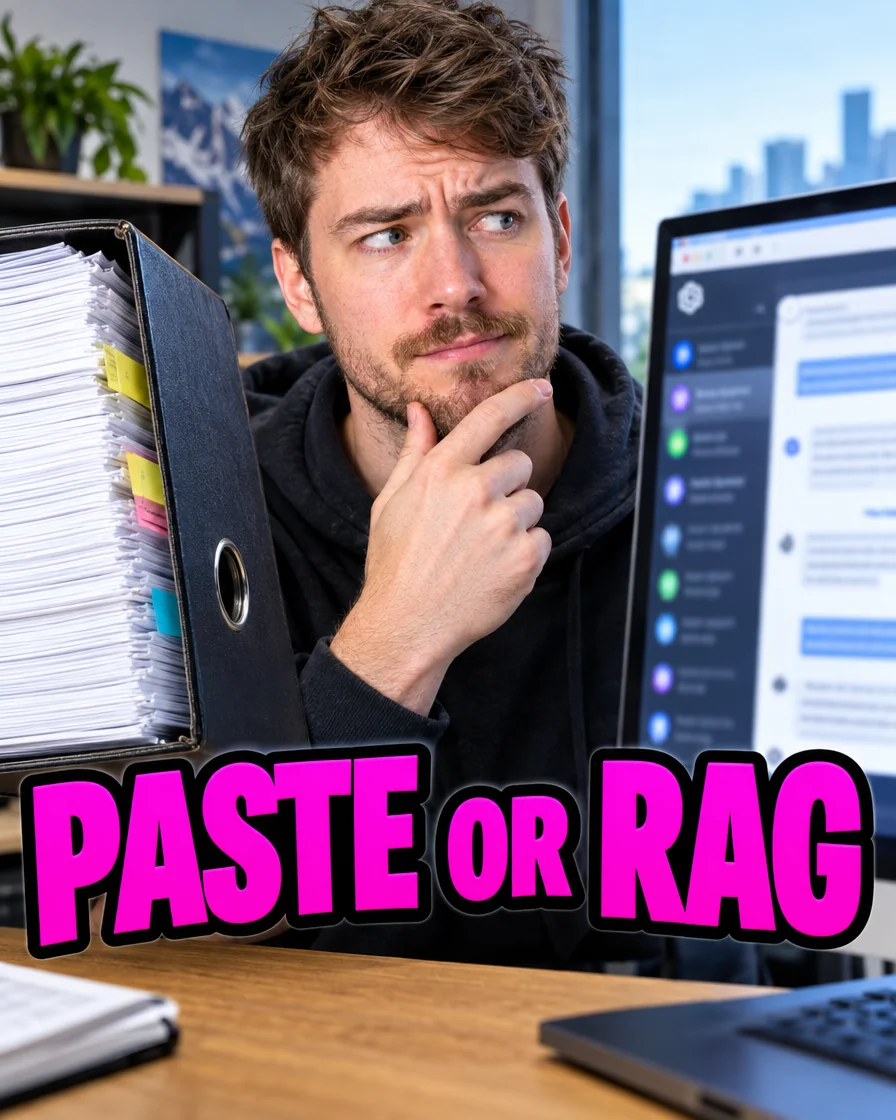
Paste a short pack into context. Retrieve when the corpus will not fit the window.
What you will be able to do
You will decide when to put documents into a chat context versus when to use retrieval-augmented generation—without buying a platform you do not need yet.
Two different moves
Paste into chat means you put the text (or a file the product inlines) into the current user message or thread. The model sees what you grounded this turn.
Retrieval means software searches a corpus, pulls likely snippets, then the model answers with those snippets in context. RAG (retrieval-augmented generation) is the common name when search and generation are wired together.
Both can be right. They fail differently. Related: personal knowledge bases and data safety.
Floor vote
Where are you with this job?
One vote per device. Change it any time.
Loading votes…
When paste is enough
Paste first when:
- The doc fits comfortably in context
- You know which section matters
- The question is one-off
- You need a tight audit trail of exactly what the model saw
- You are still learning the job and do not want retrieval mistakes mixed in
Examples: rewrite one policy page; extract actions from one meeting note; compare two vendor one-pagers you already opened.
Paste is honest. You chose the grounded context.
When retrieval starts to win
Consider retrieval when:
- You cannot remember which of twenty files holds the answer
- The corpus is larger than you want to paste
- Many people ask similar questions against the same library
- You need citations back to source files as a default
Examples: “What did we decide about refunds last quarter?” across a folder of decision logs; support FAQ draft from hundreds of tickets (after cleaning).
Retrieval is a search problem plus a generation problem. If search is wrong, the answer is confidently wrong.
Failure modes to expect
Paste failures
- You forgot the key appendix
- The thread got long and early facts fell out of the effective context
- You put secrets you should not have into the prompt
Retrieval failures
- Wrong neighbor docs ranked high
- Stale duplicates beat the current SOP
- Chunk boundaries split a table or a rule in half
- The model ignores a retrieved warning line
Design for the failure you can catch. Paste is easier to catch by eye. Retrieval needs spot checks and clean corpora.
A practical decision rule
Ask:
- Do I already know the file?
- Is it small enough to paste without pain?
- Is this a repeated question type?
If yes/yes/no → paste.
If no/—/yes → retrieval (or folder chat).
If the corpus is a mess → clean files before either path; see the hygiene steps in the personal knowledge-base guide.
How to paste well
- Provide the minimum section, not the whole binder
- Put the question after the text
- Say “use only this text; if missing, say [NEED]”
- Start a new thread when the topic changes
How to try retrieval without a science project
- Curate one folder of current docs only
- Use a product’s built-in “chat with files / project” feature if you have one
- Ask questions that should cite a known file; verify the citation
- Keep a dead-letter list of questions that failed; fix files or chunking later
Do not start by building a custom vector index unless you already know paste and folder chat are not enough. Off-the-shelf vs custom still applies.
Worked example (pattern only)
Question: “What is our on-call handoff checklist?” You know it lives in sop/oncall.md (two pages). Paste that file.
Question: “Summarize every pricing decision in 2026.” You have twelve dated decision logs. Use folder retrieval or open them in a project chat—and demand file citations.
Cost and complexity
Paste costs attention and occasional re-uploads. Retrieval costs setup, re-indexing, and debugging bad hits. For a five-person team, paid complexity should follow pain you can name weekly—not a blog post about embeddings.
How a five-person team runs this week
Pick five real questions from the last month. For each, try paste first if you know the file. Log which ones needed search across many files. Only those justify a folder-chat or retrieval trial. Clean filenames before you turn search on. If retrieval cites a stale doc, archive the stale doc the same day—do not “tune the model” to ignore garbage you left in the folder.
Field check
Field check
Four questions. Honest answers. No score sent anywhere but this page.
01 / 04
Can you name the one job this piece is for, in one sentence?
Short close
Paste when you know the source; retrieve when search is the real job—and clean the corpus either way.
Keep these
The working rules
Paste for a short pack. Retrieve when the library is too big to fit. Then: Ground the brief; Constrain generation; Keep humans on decisions; Reuse the owned template.