60 / 68
Notes into decisions
Turn messy meeting notes into a short decision log with owners and dates
AI sorts notes into decisions, owners, and dates. People still own the yes.
What you will be able to do
You will turn messy meeting notes into a short decision log with owners and dates—using AI to sort, while people still decide.
The real ops job
Most meetings do not fail for lack of talk. They fail because nobody can find, a week later:
- What was decided
- What was only discussed
- Who owns the next step
- By when
An assistant can extract and format that list fast. It cannot invent a decision that never happened. If the room never chose, the output should say so. Related: turning notes into SOPs and decision briefs.
Floor vote
Where are you with this job?
One vote per device. Change it any time.
Loading votes…
Capture raw notes without cleaning them
Paste or drop in:
- Your typed notes
- A transcript export (if you have one)
- Chat comments people left during the call
- The agenda, if one existed
Tell the model: “Do not invent decisions. Separate Decisions, Open questions, and Parking lot. Mark unclear items as [NEED].”
Cleaning too early makes you drop the awkward disagreement you still need to resolve.
Force a four-column decision log
Ask for this shape every time:
For each clear decision:
- Decision (one sentence)
- Why (one sentence, only if stated)
- Owner (name from the notes)
- Due date (only if stated; else [NEED date])
- First next step (one verb phrase)
Then: “List items that sounded like decisions but had no owner or date.”
That second list is where meetings usually leak.
Decisions vs discussion vs parking lot
Train the habit in the prompt:
- Decision — the room chose A over B (or chose to stop)
- Discussion — options, opinions, research still open
- Parking lot — important later, not this week
Ask the model to sort every bullet into one of those three. If it cannot tell, it goes in Open questions—not Decisions.
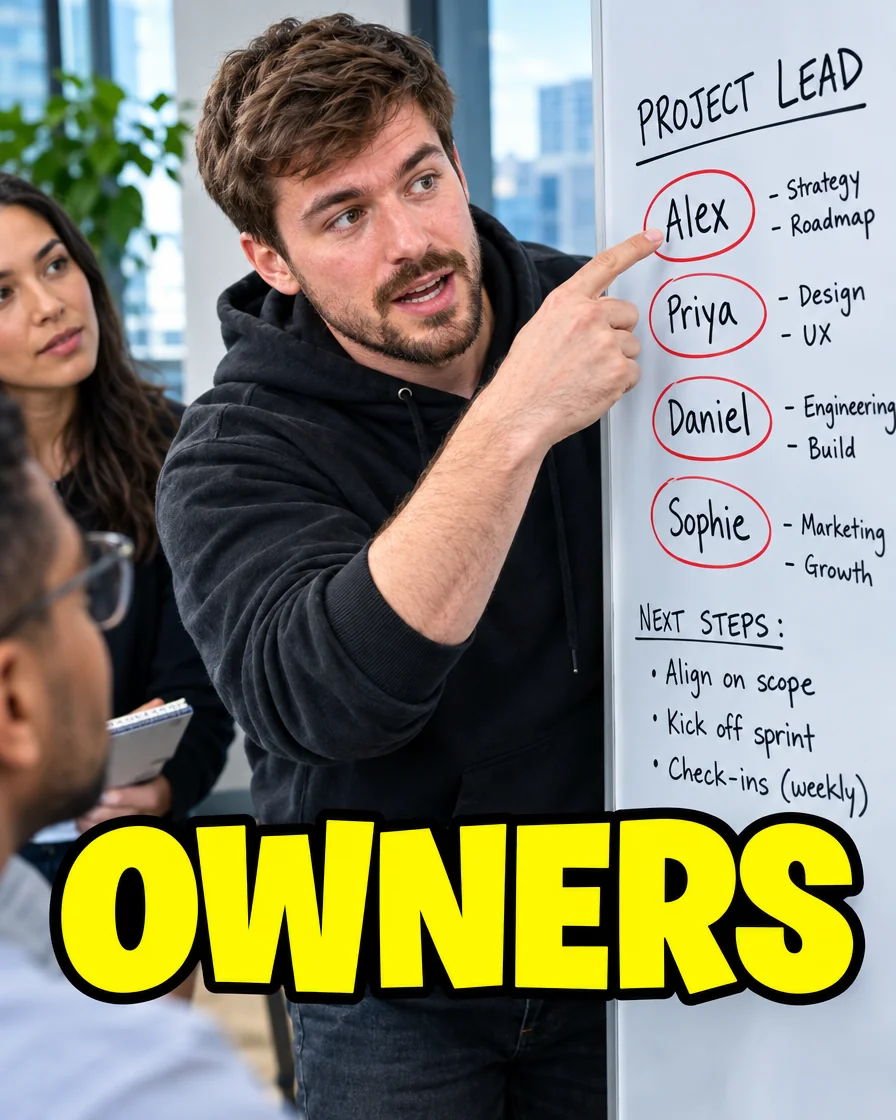
Name owners from the notes, not from vibes
Models love to invent “the team” as owner. Reject that.
Rules you paste every time:
- Owner must be a name that appears in the notes
- If no name, write
[NEED owner] - “We should” without a person is not a decision
A decision without an owner is a wish.
Close the loop in the same chat
After the log looks right:
- “Draft a 8-line summary for Slack: decisions first, then open questions.”
- “Draft calendar nudges: one line per owner + due date.”
- Paste the Slack summary into the channel the same day
Speed matters. A perfect log that sits in your downloads folder is still a failed meeting.
A 15-minute after-meeting recipe
- Export notes or paste raw bullets (2 min)
- Run the decision-log prompt (3 min)
- Fix [NEED] lines with the facilitator (5 min)
- Post Slack summary + assign tasks (5 min)
Do this while context is fresh. Waiting until Friday turns every [NEED] into archaeology.
What the model should not own
- Choosing between two product directions the room avoided
- Inventing budget numbers or ship dates
- Softening a hard no into a maybe
- Assigning work to someone who was not in the meeting
If the transcript is ambiguous, the human facilitator clarifies in the room next time—or in a follow-up thread—not by letting the model guess.
Common failure modes
- Treating “we explored” as “we decided”
- Ten owners for one action
- Due dates that say “soon”
- Summaries that bury the decision under vibe paragraphs
Fix the prompt kit once. Reuse it. Consistency beats clever one-off prompts.
Worked example (pattern only)
Notes say: “Alex will ship the pricing page copy by Thursday. We talked about a redesign but did not choose a vendor.” A good log has one decision row (pricing page copy → Alex → Thursday) and one parking-lot or open-question row (redesign vendor — not decided). If the model merges those into “Alex will lead redesign,” you caught a hallucination before it became a task.
How a five-person team runs this week
After the next three meetings only, run the 15-minute recipe before anyone stands up. Compare: did Slack get a decision summary the same day? If not, the prompt is not the problem—the posting habit is. Fix posting before you add more AI steps.
Field check
Field check
Four questions. Honest answers. No score sent anywhere but this page.
01 / 04
Can you name the one job this piece is for, in one sentence?
Short close
Sort decisions from talk, name a person and a date, post the same day—that is the useful job.
Keep these
The working rules
AI sorts notes into decisions, owners, and dates. People still own the yes. Then: Follow the steps in the article; Keep humans on final decisions; Skip invented facts; Reuse the same brief next time.